
Structure de pions
| ♔ Blancs | ♚ Noirs | |
| Pions doublés | — | — |
| Pions isolés | — | — |
| Arriérés | — | — |
| Chaînes | ● f2→e3, e3→d4 | ● f7→e6 |
| Passés | — | — |
| Majorité | — | ● aile dame 3v2 |
Cases
| ♔ Blancs | ♚ Noirs | |
| Cases fortes | ● e4 (2v0), ● b5 (2v0), ● e5 (2v1) | ● b4 (3v0), ● d5 (2v1) |
| Cases faibles | — | — |
| Centre | ● e4 (2v0), ● e5 (2v1) | ● d5 (2v1) |
Colonnes et diagonales
| ♔ Blancs | ♚ Noirs | |
| Semi-ouvertes | ● c | ● d |
Pièces
| ♔ Blancs | ♚ Noirs | |
| Bc1 | ● Bc1 Non développé (mob. 1) | |
| Bd3 | ● Bd3 Actif (mob. 11) | |
| Bc8 | ● Bc8 Non développé (mob. 1) | |
| Bf8 | ● Bf8 Non développé (mob. 2) | |
| Paire de fous | ● Oui | ● Oui |
| Non développées | 3 (● c1, ● a1, ● h1) | 4 (● c8, ● f8, ● a8, ● h8) |
Sécurité du roi
| ♔ Blancs | ♚ Noirs | |
| Statut | ● Au centre | ● Au centre |
| Droits de roque | O-O / O-O-O | O-O / O-O-O |
Thèmes
| ♔ Blancs | ♚ Noirs | |
| Phase | Ouverture | |
| Centre | mobile | |
| Ruptures | — | ● …e6-e5 |
D42 — QGD
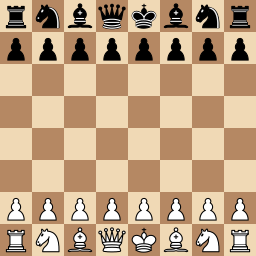
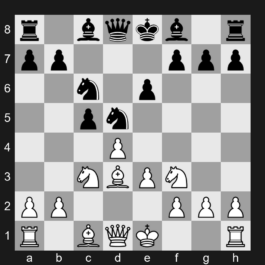
1.d4 d5 2.c4 e6 3.Nc3 Nf6 4.Nf3 c5 5.cxd5 Nxd5 6.e3 Nc6 7.Bd3 ● Trait aux Noirs
Ouverture — Centre mobile
♔ Point de vue Blancs
8
7
6
5
4
3
2
1


abcdefgh
Plans. O-O (Mettre le roi en sécurité, connecter les tours) ; Bd2 (Développer Bc1) ; h3 (Empêcher ...Bg4) ; e4 (Occuper le centre).
♚ Point de vue Noirs
1
2
3
4
5
6
7
8
hgfedcba
Plans. ...Bd7 (PRIORITÉ: libérer le Bc8 (...Bd7, b6+Bb7, ...Bg4, ...Bf5)) ; ...Be7 (Développer Bf8) ; ...e5 (Occuper le centre) ; ...c4 (Frapper le centre adverse) ; ...f6 (Poussée).
Avantages
Faiblesses
Diagonale active
Plans
├── D42d - 7…cxd4 - Semi-Tarrasch [+0.33] · 231 parties
│ └── D42d - 8.exd4 - Semi-Tarrasch (1945) [+0.27] · 231 parties
│ ├── D42e - 8…Be7 - Semi-Tarrasch (1912) [+0.39] · 216 parties
│ │ ├── D42f - 9.O-O O-O - Semi-Tarrasch (1933) [+0.29] · 206 parties
│ │ │ ├── D42j - 10.Re1 - Semi-Tarrasch (1948) [+0.40] · 125 parties
│ │ │ │ ├── D42p - 10…Bf6 - Semi-Tarrasch (1914) [+0.42] · 44 parties
│ │ │ │ │ ├── D42p - 11.Be4 - Semi-Tarrasch (1955) [+0.29] · 39 parties
│ │ │ │ │ │ ├── D42q - 11…Nce7 - Semi-Tarrasch (1957) [+0.25] · 31 parties
│ │ │ │ │ │ │ ├── D42q - 12.* - Semi-Tarrasch · 18 parties
│ │ │ │ │ │ └── D42p - 11…* - Semi-Tarrasch · 8 parties
│ │ │ │ │ └── D42p - 11.* - Semi-Tarrasch · 5 parties
│ │ │ │ ├── D42j - 10…* - Semi-Tarrasch · 30 parties
│ │ │ │ ├── D42l - 10…Nf6 - Semi-Tarrasch (1952) [+0.47] · 30 parties
│ │ │ │ │ ├── D42m - 11.a3 - Semi-Tarrasch (1963) [+0.55] · 17 parties
│ │ │ │ │ │ ├── D42m - 11…b6 - Semi-Tarrasch (1952) [+0.47] · 15 parties
│ │ │ │ │ │ │ ├── D42m - 12.* - Semi-Tarrasch · 3 parties
│ │ │ │ │ │ └── D42m - 11…* - Semi-Tarrasch · 2 parties
│ │ │ │ │ └── D42l - 11.* - Semi-Tarrasch · 3 parties
│ │ │ ├── D42g - 10.a3 - Semi-Tarrasch (1934) [+0.20] · 66 parties
│ │ │ │ ├── D42g - 10…* - Semi-Tarrasch · 27 parties
│ │ │ └── D42f - 10.* - Semi-Tarrasch · 15 parties
│ │ └── D42e - 9.* - Semi-Tarrasch · 10 parties
│ └── D42d - 8…* - Semi-Tarrasch · 15 parties
├── D42b - 7…Be7 - Semi-Tarrasch (1932) [+0.07] · 94 parties
│ └── D42b - 8.* - Semi-Tarrasch · 15 parties
Les parties, variante par variante
1231 partiesD42d - 7…cxd4 - Semi-Tarrasch
294 partiesD42b - 7…Be7 - Semi-Tarrasch (1932)
36 partiesD42a - 7…* - Semi-Tarrasch (1949)
-
D42a - 7…* - Semi-Tarrasch (1949) (6)
D42 — Queen's Gambit Declined: Semi-Tarrasch Defense, Main Line 1. d4 Nf6 2. c4 e6 3. Nf3 d5 4. Nc3 c5 5. cxd5 Nxd5 6. e3 Nc6 7. Bd3 Eval: -0.19 Vous êtes dans la ligne principale de la Semi-Tarrasch après 1.d4 Cf6 2.c4 e6 3.Cf3 d5 4.Cc3 c5 5.cxd5 Cxd5 6.e3 Cc6 7.Fd3. C'est la position tabiya de toute la Semi-Tarrasch classique, étudiée depuis les parties de Rubinstein et Capablanca dans les années 1920. Le Fou d3 vise directement h7, créant la menace latente d'une batterie Fd3 + Dc2.L'évaluation à -0.19 est légèrement favorable aux Noirs…